01 / 04
System architecture before hardware
Two-wire, IP or hybrid is decided from the number of units, cable routes and whether existing wiring stays.
Riser and cabling checked first
Video door entry, audio intercom, apartment-block panels and IP access systems for homes and buildings.
We supply door entry as a complete system: outdoor call panels, indoor monitors and handsets, power supplies, distributors, electric locks and the IP or two-wire backbone that connects them. Apartment blocks, single houses and mixed-use buildings each need a different architecture, so the number of apartments, cable routes and whether phone access is required are settled before the equipment is chosen.
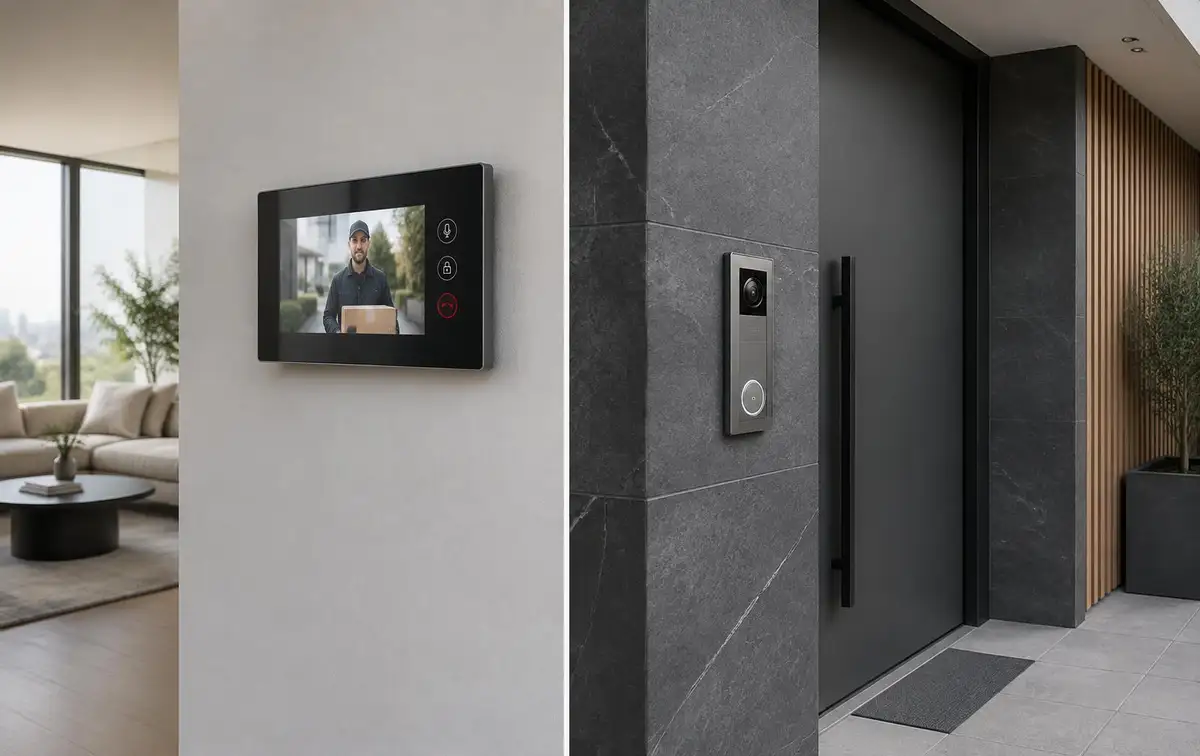
Two-wire platforms reuse much of an existing intercom riser, which is why an older block can move to video without opening every landing. IP platforms need network cabling but bring app answering, multiple entrances and integration.
A door entry system is decided by the building's cabling, not by the monitor on the wall.
We check the cabling and the apartment schedule first, then configure the panel, monitors, distributors, power supplies and locks so the installer receives a system rather than a box of parts.
Panel, monitors, distributors, power supply and lock come as one configured system with a wiring diagram.
Two-wire, IP or hybrid is decided from the number of units, cable routes and whether existing wiring stays.
Riser and cabling checked first
Two-wire and existing-cable systems let an older block upgrade to video without opening every landing.
Existing cable reused where possible
Button, keypad and display panels are configured for the actual apartment schedule, names and access rules.
Panel configured per apartment list
Electric strikes, magnetic locks, exit buttons and power supplies are specified with the panel, not sourced afterwards.
Lock and power in the same schedule
Outdoor camera panels, indoor colour monitors, handsets, distributors and power supplies
Audio panels and handsets for apartment blocks and secondary entrances
Network intercoms with app answering, multi-entrance and integration options
Electric strikes, magnetic locks, keypads, proximity readers and exit devices
Panels configured to the apartment list.
Button count, naming, keypad access and distributor layout follow the real schedule of units.
One or two entrances, answered anywhere.
Gate and front door on the same system, with app answering where an internet connection is reliable.
Access rules that match the occupants.
Different tenants, delivery access and out-of-hours rules are configured rather than improvised.
Guest access without handing over keys.
Code and credential access reduces key handovers, while the video panel keeps the entrance controlled.
What the riser contains decides whether a retrofit is simple or a rewire.
The apartment schedule sets panel type, module count and distributor quantities.
It requires internet at the building and a policy on who may answer.
Strike or magnetic lock, power supply and exit button must match the panel's outputs.
Height, weather protection and camera field of view affect daily usability.
Names, codes and addresses should stay on file for future changes.
The platform may not run on the cabling that exists, and the order becomes a rewire.
Monitors, locks and distributors all draw current; undersized supplies cause intermittent faults.
App features stop working the moment the building's connection does.
Representative selections from the catalog — indicative of what we quote, stock-source and deliver week to week. Ask for the full schedule with formats, finishes and current lead times.
Outdoor camera panels, indoor colour monitors, handsets, distributors and power supplies
Audio panels and handsets for apartment blocks and secondary entrances
Network intercoms with app answering, multi-entrance and integration options
Electric strikes, magnetic locks, keypads, proximity readers and exit devices
Panel, monitors, distributors, power supply and lock come as one configured system with a wiring diagram. This is the part most suppliers leave out: what we import, how door entry & intercom should be specified before anyone prices it, where projects lose money, and what our 1–4 wks lead time actually covers.
We supply door entry as a complete system: outdoor call panels, indoor monitors and handsets, power supplies, distributors, electric locks and the IP or two-wire backbone that connects them. Apartment blocks, single houses and mixed-use buildings each need a different architecture, so the number of apartments, cable routes and whether phone access is required are settled before the equipment is chosen.
Because we buy door entry & intercom directly from the factories, the range you see is the range we can programme — not a catalogue we hope to source later. In practice that means video door entry, audio intercom and IP & app-based systems, each with its own price band and availability, so a specification can be tuned to a budget instead of abandoned.
System architecture before hardware: two-wire, IP or hybrid is decided from the number of units, cable routes and whether existing wiring stays.
A door entry system is decided by the building's cabling, not by the monitor on the wall.
Two-wire, IP or hybrid is decided from the number of units, cable routes and whether existing wiring stays.
Two-wire and existing-cable systems let an older block upgrade to video without opening every landing.
Button, keypad and display panels are configured for the actual apartment schedule, names and access rules.
Electric strikes, magnetic locks, exit buttons and power supplies are specified with the panel, not sourced afterwards.
Specifying door entry & intercom well comes down to a short list of decisions taken in the right order — survey the existing cabling, count the units and entrances, decide app answering early, specify the lock with the system. Taken on paper, these cost nothing. Taken on site, each one is a change order.
We write the specification with you before anything is quoted, so the number you get is for the material that will actually be installed. That means confirmed dimensions and finishes, the right performance class for the space, and quantities that include the waste factor rather than discovering it mid-installation.
The same reference behaves differently depending on where it goes — apartment blocks, single houses and villas, offices and mixed-use buildings, hotels and short-term rentals each carry their own requirements, and we specify against the space rather than against a mood image.
Door entry platform running video and audio over two conductors, ideal for retrofits.
Network-based system using structured cabling, supporting apps and integration.
Device that branches the riser to individual apartments and keeps signal quality.
Lock release energised by the entry system to open the door.
Almost every delay we are called in to rescue traces back to the same handful of causes: ordering monitors before checking the riser, sizing the power supply for the panel only, choosing an IP system with no reliable network and leaving the lock to the door contractor. None of them are exotic, and all of them are avoidable at specification stage.
Ordering monitors before checking the riser is the most expensive one, because the platform may not run on the cabling that exists, and the order becomes a rewire.
We have supplied door entry & intercom into apartment blocks, houses and villas, offices and mixed use, and the pattern is consistent: the projects that run smoothly are the ones where the material was locked before the trades were booked.
Sizing the power supply for the panel only — checked once on paper, never again on site.
The platform may not run on the cabling that exists, and the order becomes a rewire.
Monitors, locks and distributors all draw current; undersized supplies cause intermittent faults.
App features stop working the moment the building's connection does.
Mismatched voltages and fail-safe versus fail-secure choices cause rework at handover.
Standard lead time on door entry & intercom is 1–4 wks from confirmed specification, and that window covers the whole chain — factory programming, consolidation, transport, customs where applicable and delivery to site or to your warehouse. We quote the landed number, not an ex-works price that grows later.
Pricing is per project rather than per line. Because we import directly and consolidate door entry & intercom with the rest of the materials for the same room, you get one quote, one delivery window and one point of contact — and the savings show up on the total, not just on a headline reference.
If you already have drawings, send them and we will come back with a specification and a landed price. If you do not, we will build the specification with you first. Either way, nothing is ordered until the quantities, finishes and dates are agreed in writing.
Often yes. Two-wire systems can reuse much of the existing riser, which avoids opening the landings of the whole block. The cabling has to be checked before ordering.
Two-wire is simpler and ideal for retrofits. IP systems run on network cable and suit new builds, multiple entrances, app answering and integration with cameras or access control.
Yes, with IP or app-enabled systems. It needs a stable internet connection at the building and a decision about who is allowed to answer.
From a few to well over a hundred, depending on the platform. The apartment schedule decides the panel type, module count and the number of distributors.
Yes. The lock, power supply, exit button and any access reader are quoted with the system so voltages and wiring match.
IP platforms integrate with cameras and building control. The integration is defined at specification stage, because it affects the panel and network choice.
Materials from this category are usually specified for office fit-out and interior design projects. If your project needs installation as well as supply, we handle both together.