01 / 04
Overflow or skimmer decided first
The two systems need different construction, balance tank and equipment; changing later means rebuilding, not re-ordering.
System type fixed at specification
Liners, mosaics, coping stones, filtration, pumps, lighting and dosing equipment for private and hospitality pools.
We supply the materials and equipment a pool needs: reinforced membranes and liners, ceramic and glass mosaic, coping and paving stones, skimmers and overflow components, filtration, pumps, heat exchangers and heat pumps, underwater lighting, dosing and treatment systems. Overflow or skimmer, volume, turnover rate and plant-room space are settled first, because they determine every piece of equipment that follows.
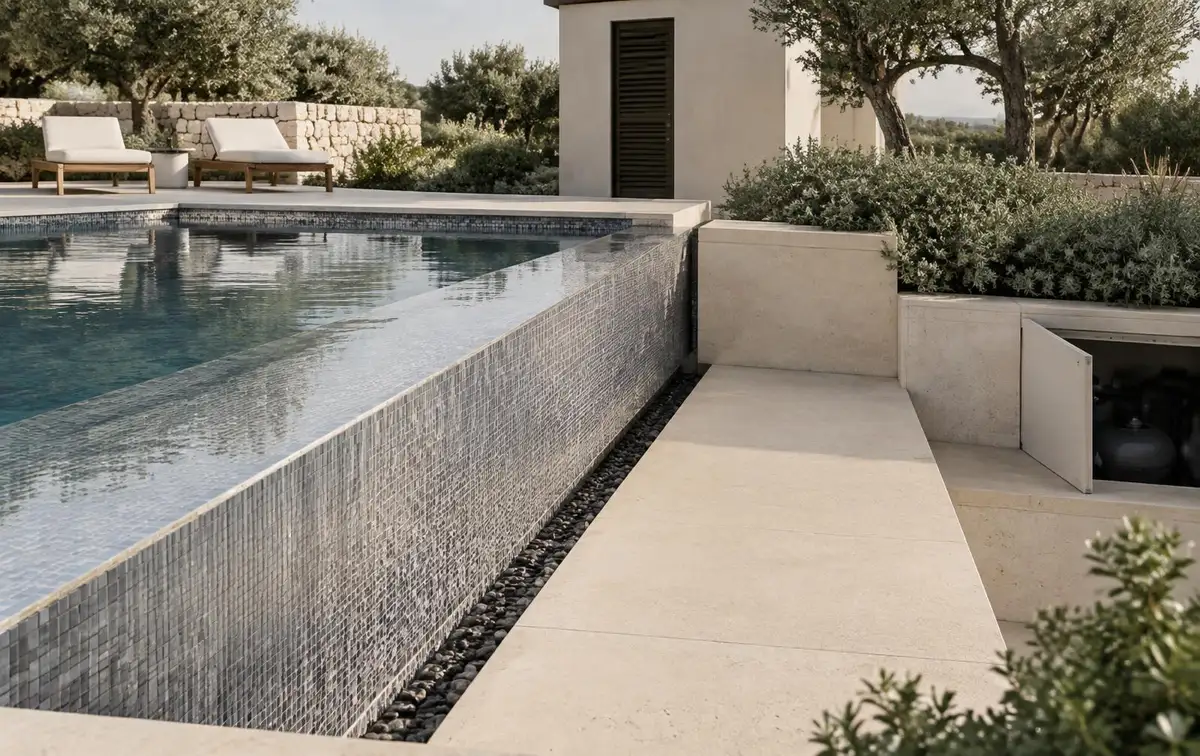
The two systems need different construction, different equipment space and, for overflow pools, a balance tank. Changing the concept after construction means rebuilding, not reordering.
A pool is hydraulics wearing a finish — the pipework decides how well it runs for twenty years.
We fix the concept, volume and turnover, then size pumps, filters and pipework, select lining, coping and lighting, and issue a plant-room layout that leaves room for service and dosing.
Lining, coping, hydraulics, heating and treatment are quoted as one package with a plant-room layout the installer can build to.
The two systems need different construction, balance tank and equipment; changing later means rebuilding, not re-ordering.
System type fixed at specification
Pump, filter and pipework are calculated from water volume and required turnover, not from a standard package.
Hydraulic calculation per pool
Mosaic, membrane and coping are selected together, because water colour comes from the combination, not from a single sample.
Space, access, drainage and dosing positions are agreed so the plant can actually be serviced.
Plant-room layout supplied
Reinforced membranes, liners, ceramic and glass mosaic and rendering systems
Stone and porcelain coping, non-slip paving and grating for overflow channels
Sand and cartridge filters, pumps, valves, skimmers, inlets and pipework components
Heat pumps, heat exchangers, LED underwater lighting, dosing, salt and UV systems
Overflow detail with a serviceable plant room.
The flush water line depends on a balance tank and pipework sized correctly for the volume.
Turnover and treatment for daily bather loads.
Commercial pools need higher turnover, monitored dosing and equipment rated for continuous operation.
Compact pools where plant space is tight.
Small pools still need correct hydraulics; the challenge is fitting the plant into a limited footprint.
New lining, coping and plant on an existing shell.
A survey decides what can stay before any material is quoted, because substrate condition drives the finish choice.
It sets construction, equipment space and cost, and it cannot be changed cheaply later.
Volume and required turnover give pump flow, filter surface and pipe diameters.
Water colour is the result of the combination, seen in daylight, not from one sample.
Space, drainage, ventilation and access decide whether maintenance is practical.
A heat pump plus a cover is usually the most economical route in Greece.
Salt, UV or dosing systems should be chosen with the hydraulics, not bolted on.
It limits flow permanently and correcting it means opening finished surfaces.
Equipment ends up crammed into a space that cannot be serviced.
Preparation requirements differ per finish; ignoring them causes failures within a season.
Representative selections from the catalog — indicative of what we quote, stock-source and deliver week to week. Ask for the full schedule with formats, finishes and current lead times.
Reinforced membranes, liners, ceramic and glass mosaic and rendering systems
Stone and porcelain coping, non-slip paving and grating for overflow channels
Sand and cartridge filters, pumps, valves, skimmers, inlets and pipework components
Heat pumps, heat exchangers, LED underwater lighting, dosing, salt and UV systems
Lining, coping, hydraulics, heating and treatment are quoted as one package with a plant-room layout the installer can build to. This is the part most suppliers leave out: what we import, how pools should be specified before anyone prices it, where projects lose money, and what our 2–8 wks lead time actually covers.
We supply the materials and equipment a pool needs: reinforced membranes and liners, ceramic and glass mosaic, coping and paving stones, skimmers and overflow components, filtration, pumps, heat exchangers and heat pumps, underwater lighting, dosing and treatment systems. Overflow or skimmer, volume, turnover rate and plant-room space are settled first, because they determine every piece of equipment that follows.
Because we buy pools directly from the factories, the range you see is the range we can programme — not a catalogue we hope to source later. In practice that means linings & finishes, coping & surrounds and filtration & hydraulics, each with its own price band and availability, so a specification can be tuned to a budget instead of abandoned.
Overflow or skimmer decided first: the two systems need different construction, balance tank and equipment; changing later means rebuilding, not re-ordering.
A pool is hydraulics wearing a finish — the pipework decides how well it runs for twenty years.
The two systems need different construction, balance tank and equipment; changing later means rebuilding, not re-ordering.
Pump, filter and pipework are calculated from water volume and required turnover, not from a standard package.
Mosaic, membrane and coping are selected together, because water colour comes from the combination, not from a single sample.
Space, access, drainage and dosing positions are agreed so the plant can actually be serviced.
Specifying pools well comes down to a short list of decisions taken in the right order — decide overflow or skimmer at design stage, calculate turnover, then size the plant, select lining and coping together, plan the plant room for service. Taken on paper, these cost nothing. Taken on site, each one is a change order.
We write the specification with you before anything is quoted, so the number you get is for the material that will actually be installed. That means confirmed dimensions and finishes, the right performance class for the space, and quantities that include the waste factor rather than discovering it mid-installation.
The same reference behaves differently depending on where it goes — private villas and houses, hotels and resorts, holiday rentals, wellness and spa facilities each carry their own requirements, and we specify against the space rather than against a mood image.
Pool where water flows over the edge into a channel and a balance tank.
Pool with water level below the coping, using skimmers to draw surface water.
Time required to circulate the whole water volume through the filtration system.
Buffer tank storing the water displaced by bathers in an overflow system.
Almost every delay we are called in to rescue traces back to the same handful of causes: undersizing the pipework, leaving the plant room to the end, choosing mosaic on a substrate that cannot take it and heating without a cover. None of them are exotic, and all of them are avoidable at specification stage.
Undersizing the pipework is the most expensive one, because it limits flow permanently and correcting it means opening finished surfaces.
We have supplied pools into villa pools, hotel pools, small and plunge pools, and the pattern is consistent: the projects that run smoothly are the ones where the material was locked before the trades were booked.
Leaving the plant room to the end — checked once on paper, never again on site.
It limits flow permanently and correcting it means opening finished surfaces.
Equipment ends up crammed into a space that cannot be serviced.
Preparation requirements differ per finish; ignoring them causes failures within a season.
Overnight losses make running costs far higher than the calculation suggested.
Standard lead time on pools is 2–8 wks from confirmed specification, and that window covers the whole chain — factory programming, consolidation, transport, customs where applicable and delivery to site or to your warehouse. We quote the landed number, not an ex-works price that grows later.
Pricing is per project rather than per line. Because we import directly and consolidate pools with the rest of the materials for the same room, you get one quote, one delivery window and one point of contact — and the savings show up on the total, not just on a headline reference.
If you already have drawings, send them and we will come back with a specification and a landed price. If you do not, we will build the specification with you first. Either way, nothing is ordered until the quantities, finishes and dates are agreed in writing.
Overflow pools look flush with the deck and need a balance tank and more equipment space. Skimmer pools cost less and are simpler to maintain. The decision belongs at design stage, not later.
Reinforced membrane is fast and repairable, mosaic gives the most durable and premium finish at higher cost, and liners suit budget or renovation work. Each needs a different substrate preparation.
A heat pump is usually the most economical option in the Greek climate, and a cover reduces consumption significantly. Sizing depends on volume, exposure and how many months you swim.
From water volume and required turnover, which set the pump flow, filter surface and pipe diameters. Undersized pipework is a common and expensive mistake to correct.
Yes. Renovation usually means new lining, coping, hydraulics and plant. We survey what can stay before quoting the materials.
Yes. Commercial pools need higher turnover, treatment and monitoring, and the equipment is specified for continuous operation and daily maintenance.
Materials from this category are usually specified for interior design projects and retail fit-out. If your project needs installation as well as supply, we handle both together.