01 / 04
Output calculated by room
Room size, exposure and insulation are considered before wattage is proposed, avoiding both underheating and unnecessary installed load.
Wattage schedule per room
Electric radiators, convectors, infrared panels and towel rails for homes, rentals and professional spaces.
We supply electric heating appliances for spaces where independent, controllable heat is the practical answer: electric radiators, convectors, infrared panels, towel rails and portable units. The choice is based on room volume, insulation, operating hours and control needs, with electrical load and mounting requirements checked before the order.
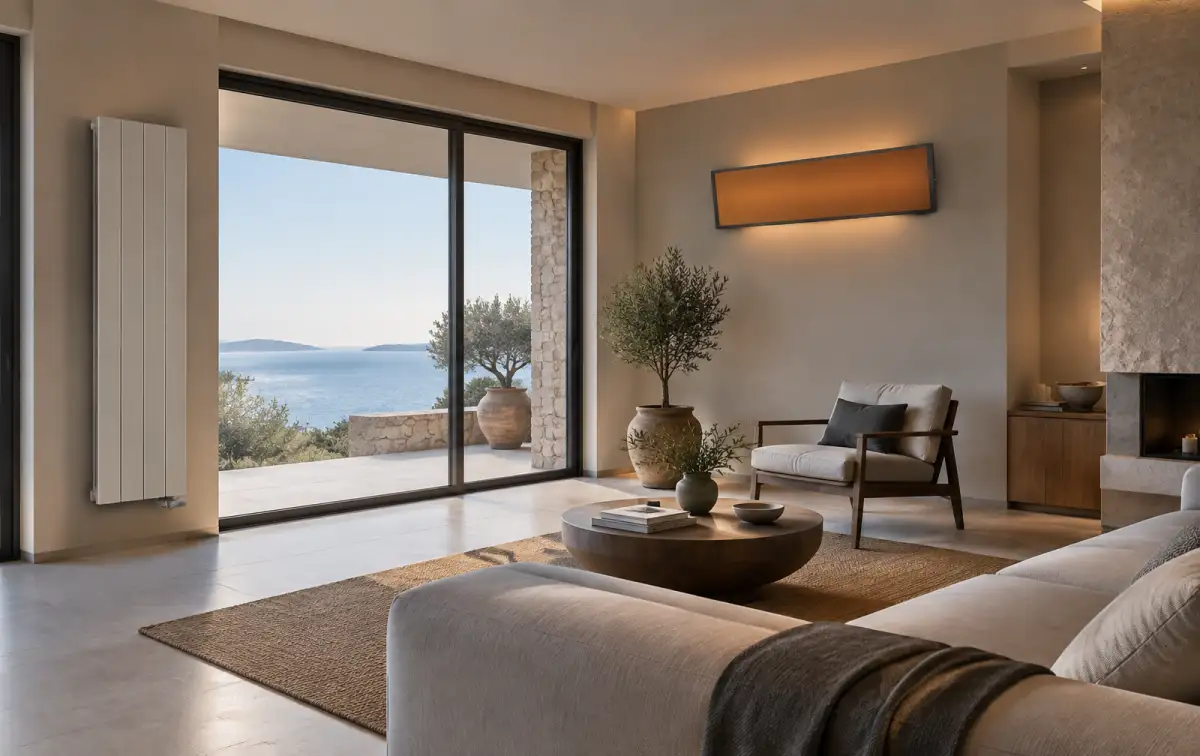
A holiday property used on weekends needs a different response from a bedroom heated every evening. Wattage alone does not describe comfort, control or running pattern.
Electric heat is simple only after the room load and the electrical load have both been calculated.
We compare heat loss, operating hours, wall space and controls, then schedule each unit with its output and electrical requirement for the installer.
A single room schedule prevents mismatched outputs, overloaded circuits and a different control system in every room.
Room size, exposure and insulation are considered before wattage is proposed, avoiding both underheating and unnecessary installed load.
Wattage schedule per room
Manual, weekly programming and connected control are matched to a permanent home, rental or intermittently used space.
Control strategy included
Total connected load and circuit requirements are reviewed before multiple units are ordered for a property.
Load list for the electrician
Models, outputs and mounting positions are coordinated room by room for renovations, hotels and rental portfolios.
Consolidated appliance schedule
Wall-mounted fluid and dry-element radiators with thermostatic control
Fast-response wall-mounted and portable heating for intermittent use
Radiant wall and ceiling panels for targeted comfort and clean interiors
Bathroom heating and towel drying in multiple sizes and finishes
Steady heat with controls the household will use.
Output and programming are balanced for regular occupied hours and the room's heat loss.
Fast, independent heat for intermittent stays.
Connected controls and quick-response appliances suit properties that are not continuously occupied.
Comfort and towel drying with bathroom-safe equipment.
Appropriate ingress protection and permitted installation zones guide model and position.
Repeatable models with simple guest operation.
A standardised schedule keeps controls familiar and replacement straightforward across rooms.
Use more than floor area; height, insulation, glazing and exposure all affect output.
Quick convective heat and steady radiant heat suit different patterns.
Multiple room units can require circuit or supply changes even when each appliance is modest.
Weekly programming and remote access should be requirements, not afterthoughts.
Only appropriately rated equipment may be installed in the permitted location.
Shared controls and a repeat model simplify daily use and future replacement.
It ignores insulation, ceiling height, climate and glazing.
A full-house schedule can exceed available electrical capacity.
Cables, stability and poor control make them unsuitable for many long-term layouts.
Representative selections from the catalog — indicative of what we quote, stock-source and deliver week to week. Ask for the full schedule with formats, finishes and current lead times.
Wall-mounted fluid and dry-element radiators with thermostatic control
Fast-response wall-mounted and portable heating for intermittent use
Radiant wall and ceiling panels for targeted comfort and clean interiors
Bathroom heating and towel drying in multiple sizes and finishes
A single room schedule prevents mismatched outputs, overloaded circuits and a different control system in every room. This is the part most suppliers leave out: what we import, how electric heating appliances should be specified before anyone prices it, where projects lose money, and what our 1–4 wks lead time actually covers.
We supply electric heating appliances for spaces where independent, controllable heat is the practical answer: electric radiators, convectors, infrared panels, towel rails and portable units. The choice is based on room volume, insulation, operating hours and control needs, with electrical load and mounting requirements checked before the order.
Because we buy electric heating appliances directly from the factories, the range you see is the range we can programme — not a catalogue we hope to source later. In practice that means electric radiators, convectors & thermoconvectors and infrared panels, each with its own price band and availability, so a specification can be tuned to a budget instead of abandoned.
Output calculated by room: room size, exposure and insulation are considered before wattage is proposed, avoiding both underheating and unnecessary installed load.
Electric heat is simple only after the room load and the electrical load have both been calculated.
Room size, exposure and insulation are considered before wattage is proposed, avoiding both underheating and unnecessary installed load.
Manual, weekly programming and connected control are matched to a permanent home, rental or intermittently used space.
Total connected load and circuit requirements are reviewed before multiple units are ordered for a property.
Models, outputs and mounting positions are coordinated room by room for renovations, hotels and rental portfolios.
Specifying electric heating appliances well comes down to a short list of decisions taken in the right order — calculate room heat loss, match response to occupancy, check the total connected load and choose controls before the model. Taken on paper, these cost nothing. Taken on site, each one is a change order.
We write the specification with you before anything is quoted, so the number you get is for the material that will actually be installed. That means confirmed dimensions and finishes, the right performance class for the space, and quantities that include the waste factor rather than discovering it mid-installation.
The same reference behaves differently depending on where it goes — homes and apartments, holiday properties, hotel rooms, offices and studios each carry their own requirements, and we specify against the space rather than against a mood image.
Appliance that warms air as it moves across a heating element.
Radiant appliance that transfers heat directly to surfaces and occupants.
Temperature difference between switching the heater on and off.
Combined electrical power of all appliances on the installation.
Almost every delay we are called in to rescue traces back to the same handful of causes: applying one watts-per-square-metre rule, ignoring the property's main supply, using portable units as permanent design and buying connected units without checking the platform. None of them are exotic, and all of them are avoidable at specification stage.
Applying one watts-per-square-metre rule is the most expensive one, because it ignores insulation, ceiling height, climate and glazing.
We have supplied electric heating appliances into living spaces, holiday homes and bathrooms, and the pattern is consistent: the projects that run smoothly are the ones where the material was locked before the trades were booked.
Ignoring the property's main supply — checked once on paper, never again on site.
It ignores insulation, ceiling height, climate and glazing.
A full-house schedule can exceed available electrical capacity.
Cables, stability and poor control make them unsuitable for many long-term layouts.
App features and connectivity vary; confirm exactly what the chosen model supports.
Standard lead time on electric heating appliances is 1–4 wks from confirmed specification, and that window covers the whole chain — factory programming, consolidation, transport, customs where applicable and delivery to site or to your warehouse. We quote the landed number, not an ex-works price that grows later.
Pricing is per project rather than per line. Because we import directly and consolidate electric heating appliances with the rest of the materials for the same room, you get one quote, one delivery window and one point of contact — and the savings show up on the total, not just on a headline reference.
If you already have drawings, send them and we will come back with a specification and a landed price. If you do not, we will build the specification with you first. Either way, nothing is ordered until the quantities, finishes and dates are agreed in writing.
There is no reliable single figure for every room. Area, ceiling height, insulation, glazing, exposure and location must be considered before output is selected.
A convector responds quickly by warming moving air, while many electric radiators provide steadier heat through a heated body or fluid. The better choice depends on operating hours and comfort preference.
They can be in suitable, well-assessed spaces, but coverage, mounting position and heat loss must be checked rather than assumed.
Many ranges offer connected thermostats or app control. We confirm the available control system for each model before quoting.
Only products with the appropriate ingress protection and installation-zone approval should be used. Electric towel rails are commonly selected where compliant placement is available.
Yes. Send room areas or plans and we can prepare a model and output schedule, then quote the appliances as one coordinated order.
Materials from this category are usually specified for interior design projects. If your project needs installation as well as supply, we handle both together.